Every post on this blog so far has been about the agency-facing side of PtahCast — the board, the forecast page, the flow metrics, the accountability log. That's deliberate; it's where the actual forecasting happens. But on Agency and Scale plans, there's a second surface entirely: a white-labeled portal the client sees, and it's worth walking through on its own terms, because what belongs there is a genuinely different question from what belongs on the internal board.
What the client actually sees
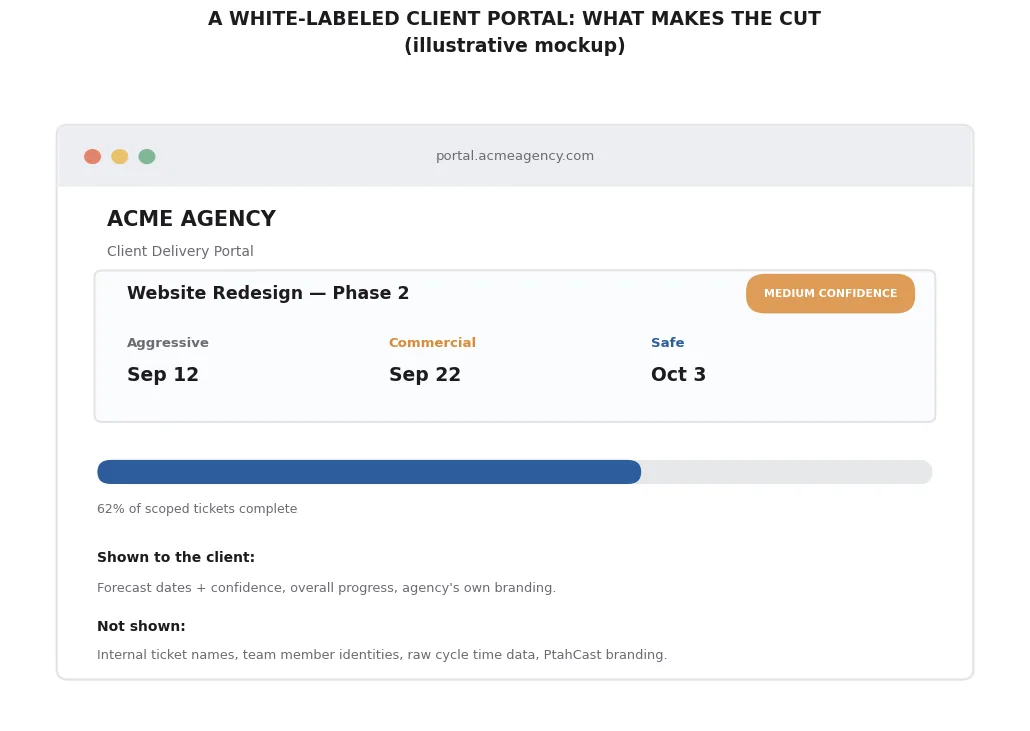
The mockup above is illustrative, not a live screenshot, but it's structurally accurate to what a client-facing view looks like. At the top: the agency's own name and branding — not PtahCast's. Underneath that, the forecast itself: the same three dates covered in the first post on this blog — Aggressive, Commercial, Safe — presented with the confidence label from the confidence levels post, so the client isn't just seeing a date, they're seeing how much weight that date can bear. Below that, an overall progress indicator — not a ticket-by-ticket breakdown, just a clear sense of how much of the scoped work is done.
What's deliberately left out
The interesting design decisions in a client portal are mostly about omission. Internal ticket names and descriptions don't appear — client-facing progress doesn't require exposing the agency's internal task breakdown, and often shouldn't, for reasons that have nothing to do with hiding anything and everything to do with the client not needing (or wanting) that level of granularity. Individual team member identities don't appear either; the client is working with the agency, not auditing which specific person is behind on which ticket. Raw cycle time and throughput numbers stay internal too — those are the agency's own operating data, useful for running the engagement, not something a client needs exposed to understand when the work will be done.
And, on Agency and Scale plans, PtahCast's own branding doesn't appear at all. The portal reads as the agency's own tool, on the agency's own subdomain, because from the client's perspective, it should.
Why the omissions matter as much as what's shown
A client-facing portal that showed everything the agency-facing board shows wouldn't be more transparent — it would just be noisier, and it would blur a distinction worth keeping clear: the internal board is a working tool for the team doing the work, and the client portal is a communication surface for the person paying for the outcome. Those are different jobs. Optimizing the client view for "shows everything" instead of "shows what the client actually needs to make a decision" tends to bury the one number a client is actually there for — the date, and how sure the agency is of it — under detail that doesn't help them and occasionally raises questions that weren't worth raising.
Why this matters for the white-label plans specifically
The white-label branding isn't a cosmetic upsell. An agency that hands a client a portal branded as a third-party vendor's product is quietly reminding that client, every time they check it, that there's a tool in the middle of the relationship. An agency that hands a client a portal that looks like their own is reinforcing the opposite — that the agency itself has a rigorous, data-backed process behind the dates it commits to. Same underlying forecast, meaningfully different impression.