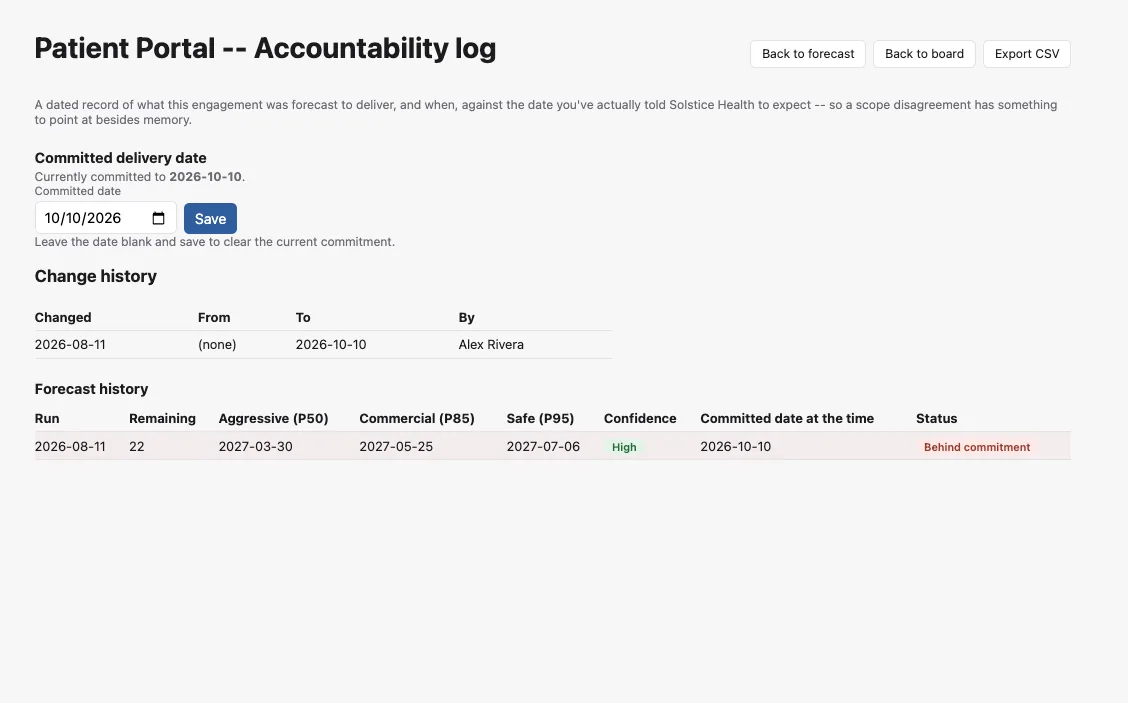
A forecast is only useful if someone can check it later. Most agencies never do this in any formal way — a PM says a date out loud or writes it into a Slack message, the project moves on, and by the time it actually ships (or doesn't), nobody goes back to compare the two. The forecast quietly disappears, whether it was right or wrong.
An accountability log is the fix: a permanent, dated record of every forecast a team has made for a piece of work, alongside the commitment date that was actually given to the client at the time, and what happened afterward. In PtahCast, that means every time a forecast is run, the Aggressive (P50), Commercial (P85), and Safe (P95) dates are saved along with the committed delivery date in effect on that day — and the log flags, plainly, whether the engagement is on track or already behind that commitment.
This sounds like a small bookkeeping feature. In practice it changes how forecasting gets used. Without a log, there's no cost to giving an optimistic date — nobody's checking, so an agency can quietly move the goalposts each time a deadline gets close, and the client only sees a single new date each time, never the pattern behind it. With a log, every forecast is on the record. If the commercial date keeps sliding out, that's visible immediately, not months later in a post-mortem. It creates a real incentive to give a defensible number the first time, because the alternative is a visible trail of having been wrong.
It also changes the conversation with clients in a good way. An agency that can show a client its forecast history — including the times it was behind — reads as more credible, not less, because the alternative most clients have experienced is agencies who never show their work at all. A single clean date with nothing behind it is easy to promise and easy to break. A dated, running record of forecasts versus outcomes is much harder to fake, and that's exactly what makes it worth something.
The accountability log isn't a punishment mechanism. It's what makes the rest of the forecast trustworthy — a Monte Carlo simulation is only as credible as the willingness to be checked against it later.