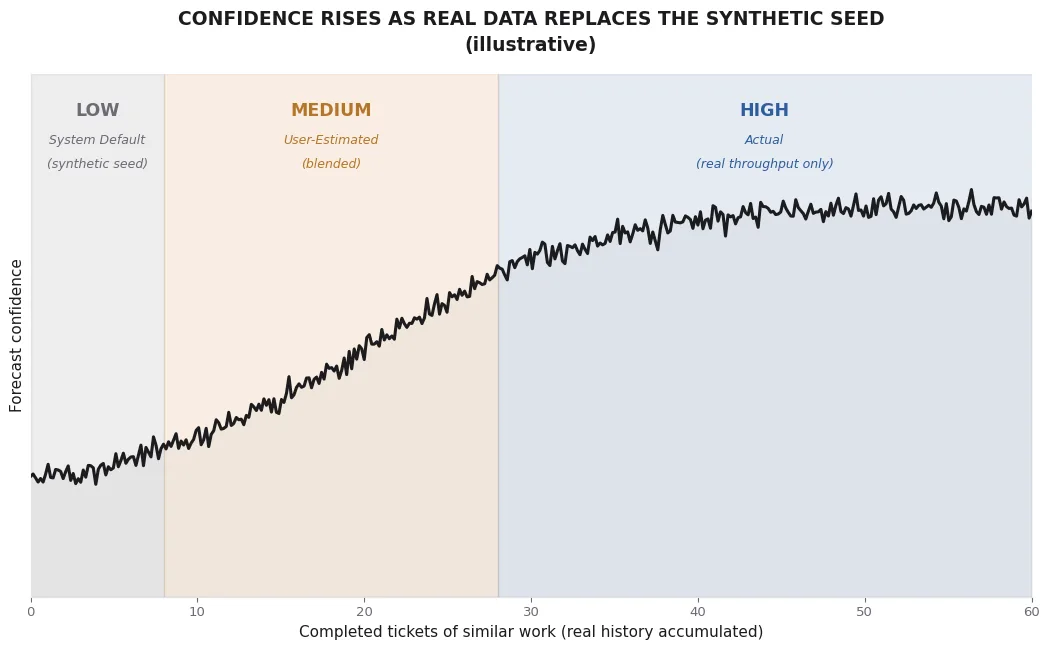
Every PtahCast forecast shows three dates — Aggressive, Commercial, Safe — and something else that's easy to skim past: a confidence label. Low, Medium, or High. The cold-start post mentioned the three tiers behind that label in passing — System Default, User-Estimated, Actual — but never pulled the thread on what actually moves a forecast from one to the next, or why that label deserves as much attention as the date sitting next to it.
The three tiers, and what's actually behind each one
Low — System Default. No completed tickets of this type exist yet, so the forecast runs on a synthetic seed: a Poisson distribution parameterized from reasonable defaults, honestly labeled as a placeholder rather than dressed up as data. It's a real, usable starting point for a conversation — just not one that's earned any trust yet.
Medium — User-Estimated. A handful of real tickets have closed, or someone with direct knowledge of the team has entered a manual throughput estimate to blend with the synthetic seed. The forecast is now partly grounded in something real, partly still leaning on an assumption. It's better than a guess, and it's still not the same claim as a forecast built entirely from observed behavior.
High — Actual. Enough tickets have closed that the forecast runs entirely on this team's own completed work — no synthetic component left in the model at all. This is the tier every engagement eventually reaches, and the one where the confidence label and the underlying math finally say the same thing.
Why the label matters more than the date itself
Two forecasts can show the exact same commercial date and mean completely different things. A Commercial (P85) date of October 3rd, rated High confidence, built on four months of this exact team's throughput, is a strong claim. A Commercial (P85) date of October 3rd, rated Low confidence, generated on day one from a synthetic seed, is a reasonable starting estimate that happens to land on the same calendar day — and treating those two as equivalent is exactly the kind of false precision this blog keeps arguing against. The date is the headline. The confidence label is what tells you how much weight the headline can actually bear.
This is also exactly the kind of distinction worth disclosing up front rather than discovering later — see the delivery clause post for language that states a confidence level explicitly rather than leaving a client to assume every date carries the same certainty.
What actually moves the needle
Three things drive the climb from Low to High, and they're worth understanding individually because they don't always move together:
Volume. More completed tickets of relevant work is the most direct lever — a forecast built on 40 closed tickets has a materially larger sample to resample from than one built on 4.
Relevance. Not all completed tickets count equally. Ten closed tickets from the exact type of work being forecasted move confidence further than fifty closed tickets from an unrelated part of the backlog. Volume without relevance doesn't earn as much trust as it looks like it should.
Consistency. A team with tight, low-variance cycle times converges to High confidence faster than a team whose cycle times are all over the place, because a noisy history takes more data points to characterize reliably. This is also a reason confidence and runaway WIP are connected — high WIP tends to produce exactly the kind of noisy, inconsistent cycle time data that keeps a forecast stuck at Medium longer than it needs to be.
Don't wait for High to make decisions
None of this is an argument for refusing to forecast until a team has months of history — that's exactly the trap the cold-start post was written to avoid. A Low-confidence forecast on day one is still more honest than no forecast at all, and still better than a single-point guess with no confidence label attached to it whatsoever. The point isn't to wait for High. It's to read the label as part of the forecast, communicate it accordingly, and let it rise on its own as real data accumulates — which it will, automatically, without anyone needing to remember to recalibrate anything by hand.