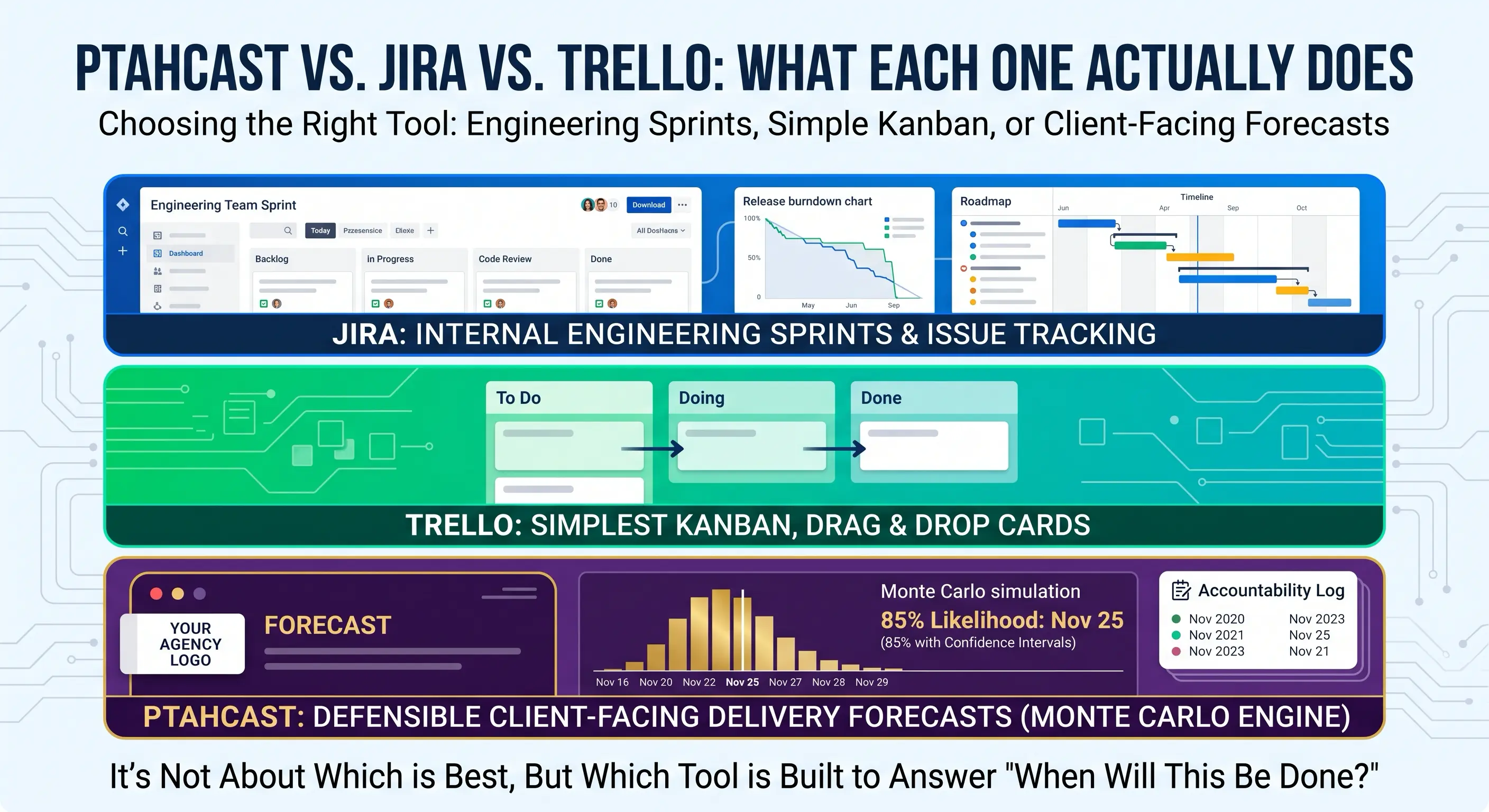
These three don't actually compete for the same job, and it's worth saying that before comparing them line by line. Jira is a general-purpose issue tracker built for engineering teams running sprints. Trello is the simplest kanban board that exists — lists, cards, drag them across. PtahCast is neither of those; it's a board built specifically around answering one question an agency owner gets asked constantly: when will this be done, and how sure are you? The useful comparison isn't "which tool is best," it's "which one of these was actually built to answer that question" — and the honest answer is that two of the three were never trying to.
What Jira gives you
Jira's sprint reports, release burndowns, and roadmap timelines are genuinely strong for sequencing engineering work and tracking whether a sprint is on pace. What Jira doesn't have natively is any probabilistic forecasting — no built-in Monte Carlo simulation, no native way to express "85% likely by this date" instead of a flat commitment. That gap is solvable with a marketplace plugin, and for a team already deep in the Jira ecosystem, that's often the path of least resistance. The full breakdown of Jira plus a forecasting plugin, versus PtahCast, is its own article — the short version is that the output stays built for an internal, engineering-facing audience, on top of Jira's per-user licensing.
What Trello gives you
Trello's entire value proposition is that it gets out of your way. Lists, cards, drag-and-drop — a board any team can set up in five minutes with effectively no learning curve. That simplicity is real and it's not a knock; plenty of small teams and personal projects need exactly that and nothing more. But it means Trello has no native WIP limits (a Power-Up can bolt them on), no native cycle time or throughput reporting, and no forecasting of any kind — not even a simple burndown, let alone a probability distribution. Asking Trello to answer "when will this be done, with what confidence" is asking it to be a different category of tool than the one it was built as. That's not a flaw in Trello; it's just not what it's for.
Where PtahCast is a different kind of tool
PtahCast isn't a lighter Jira or a heavier Trello — it's a kanban board with a Monte Carlo forecasting engine built into its core, designed around a problem neither Jira nor Trello was built to solve: giving an external client a delivery forecast that's actually meant for them to see.
Client-facing by design. On the Agency and Scale plans, the forecast a client sees is white-labeled — your logo, your color, your own domain — not an internal board with your ticket noise on it. What actually shows up in that portal is deliberately a subset of what your team sees internally.
Priced per client, not per seat. Jira licensing scales with headcount, and Trello's paid tiers do too. PtahCast's plans scale with how many client engagements you're running instead — three, ten, or twenty-five. The reasoning behind that is its own post, but it tends to track an agency's actual cost structure more closely than a per-user model does.
An accountability log, not just a board. Every forecast PtahCast runs is saved alongside the commitment date given to the client, so there's a permanent, dated record of whether past forecasts held up — the thing that turns a probability curve into something a client learns to trust over more than one engagement.
You don't have to re-type a backlog to get there. PtahCast can import directly from either Jira Cloud or a Trello board — connect it, map the external statuses onto your PtahCast columns, and pull tickets in without hand-entering them. It's one-directional and configured per board, so keeping Jira or Trello as the day-to-day system of record doesn't mean choosing between that and a client-facing forecast built on real data.
When each one is the right call
If the actual need is internal engineering visibility — sprint tracking, release sequencing, a team already invested in the Jira ecosystem — Jira, with a forecasting plugin if probabilistic dates matter, is very likely the simpler path. If the need is genuinely lightweight — a small team or a personal project that just needs to see what's where, with no client-facing forecast in the picture — Trello does that with less setup than anything else on this list. If the actual pressure point is a client asking "when will this be done" and the honest answer needs to leave the building as a defensible date with a record behind it, that's the specific problem PtahCast is built around, board and forecast together — and it can sit next to whichever of the other two you're already using, not instead of it.