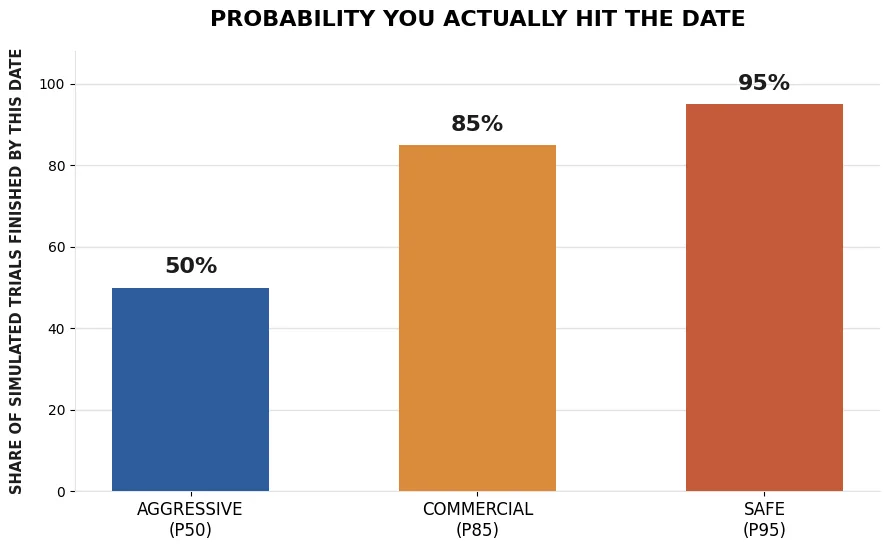
Every PtahCast forecast hands you three dates: Aggressive, Commercial, Safe. Explaining what they mean is the easy part — it's covered in the first post on this blog. The harder, more practical question never gets a clean answer anywhere: when you're actually writing the email to a client, which one do you type?
That's a different decision than understanding the math, and it deserves its own framework.
What each one is actually for
P50 (Aggressive) is the midpoint of every simulated outcome — the date half of all simulated futures beat, and half didn't. By construction, a forecast pegged to P50 is wrong, in the "later than promised" direction, roughly half the time. That's not a flaw in the number. It's what "50th percentile" means. It's an excellent number for internal planning — sprint targets, resourcing conversations, the "when do we honestly think this lands" chat with the team — and a bad one to put in front of a client, because you're volunteering a coin flip and calling it a commitment.
P85 (Commercial) is the default client-facing number for a reason: it's aggressive enough to still feel like a real target, and safe enough that you land inside it the large majority of the time. Eighty-five out of a hundred simulated futures finished by this date. That's the number this blog and the product both treat as the standard answer when someone asks "so what do I tell them" — not because it's always right, but because it's the sane default when nothing else about the situation says otherwise.
P95 (Safe) is the number for when being late isn't just annoying, it's expensive or reputationally costly — a fixed-price contract with a penalty clause, a launch tied to a paid ad campaign already booked, a client who's already burned once by a previous vendor and is watching closely. Ninety-five out of a hundred simulated futures beat this date. It's a wide margin, and margin is exactly what those situations are buying.
Three questions that actually decide it
What happens if we're late? A mildly annoyed client and an internal deadline slip are a P85 situation. A contractual penalty, a hard external launch date, or a client relationship that's already fragile are P95 situations. This single question does most of the work — most engagements are P85 by default, and it's the exceptions that need P95.
How much history backs this forecast? A forecast built on six months of real cycle time data deserves more trust at P85 than one built on a week of synthetic cold-start data (see the cold-start post for how that confidence label works). Thin history is itself a reason to lean safer, independent of anything else about the engagement.
Is this a one-time promise or a recurring relationship? For a long-running client relationship, a P85 commitment that's visibly tracked in an accountability log builds more trust over time than a P95 number that's so padded it never actually gets tested. A date that's always trivially easy to hit stops meaning anything. For a one-off, high-stakes engagement, that logic reverses — there's no "over time" to build trust across, so the safer number is usually right.
The mistake worth naming directly
The single most common way this goes wrong isn't picking P95 too often out of caution. It's quoting P50 because it's the earliest, most impressive-sounding date on the page, and it feels like the "confident" answer to give a client who's asking to move fast. It isn't confidence. It's a coin flip wearing a commitment's clothes — the exact failure mode the first post on this blog was written to argue against in the first place. If P50 is the number in the email, don't be surprised when it's also the number in a difficult conversation a few weeks later.
Let the accountability log tell you if you're calibrated
Whichever percentile becomes the default, that choice is itself something worth watching over time. If P85 commitments are landing on time closer to 60% of the time instead of the expected 85%, that's not bad luck — it's a sign the underlying cycle time data is noisier than the model assumes, and it's worth a look at flow metrics before the next commitment goes out. The accountability log exists exactly for this: not just to record whether a single date was hit, but to show whether a chosen percentile is actually behaving the way its number claims it should.