This is a starting point for a conversation with your own counsel, not legal advice — have any contract language reviewed by a lawyer before it goes into a real agreement.
Most statements of work handle the delivery date in one line: "Contractor shall deliver the Work by [date]." That single line is where a disproportionate share of agency-client conflict actually starts — not at the missed date itself, but at the moment the contract implied a certainty nobody actually had. A bare date makes no allowance for the fact that estimates are estimates. When reality diverges even slightly, the contract offers nothing but a broken promise, and the conversation starts from an adversarial place by default.
A clause built around a confidence level instead of a bare date changes that starting point, without giving up anything a client actually needs.
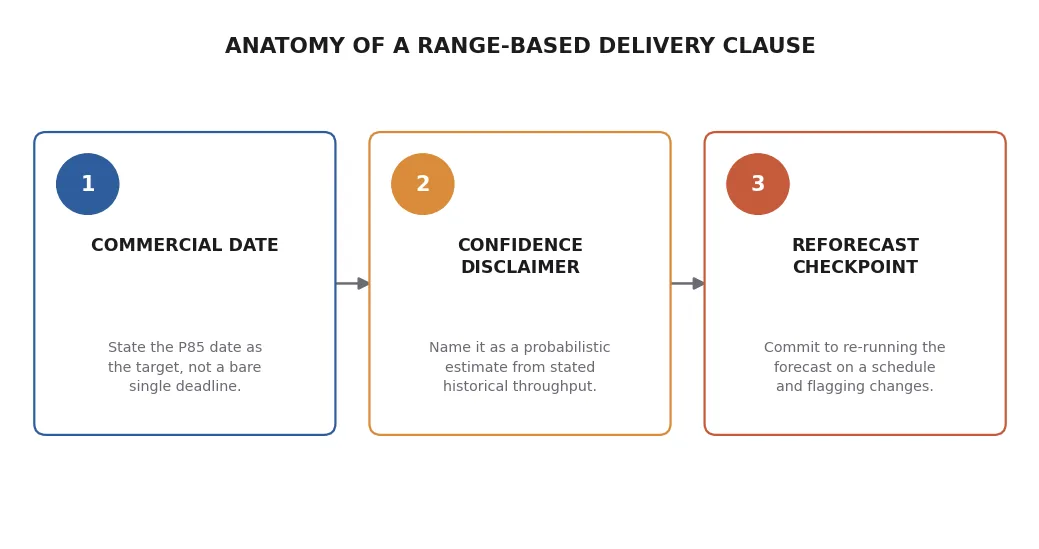
Three components, not one date
1. A commercial target date. This is your P85 — the date you can defend, not the most optimistic one on the forecast. See the previous post for the full reasoning on why P85 is usually the right default for a client-facing commitment.
2. An explicit confidence disclaimer. State plainly that the date is a probabilistic estimate derived from actual historical delivery data, not a guarantee. This isn't hedging — it's accuracy. It also does real work if a dispute ever arises: a stated confidence level, backed by real data, is a defensible position. A bare date with nothing behind it is not.
3. A reforecast checkpoint. Commit to re-running the forecast on a set cadence — monthly, or at defined milestones — and to notifying the client promptly if the forecast materially changes. This is the clause equivalent of an accountability log: instead of one prediction made once and never revisited, it's a standing commitment to keep the client's information current as reality updates it.
Starting-point language
Something close to this, adapted to your own engagement and reviewed by counsel before use:
"Contractor forecasts delivery of the Work on or before [commercial date], based on Contractor's actual historical throughput as of the date of this Agreement. This date represents an estimate at an [85%] confidence level, not a guaranteed deadline. Contractor will re-run this forecast at each [monthly / milestone] checkpoint over the course of the engagement and will notify Client promptly of any material change to the forecast delivery window."
Why this protects the agency too
It's easy to read this as a clause that only benefits the client — more transparency, more communication, more accountability. It protects the agency just as much. A single bare date is a binary: hit it, or explain a failure with nothing on the record to support the original estimate. A stated confidence level, backed by real cycle time and throughput data, gives an agency something to point to when a date shifts for legitimate reasons — the estimate was never a guarantee, it was a defensible number with a stated basis, and that basis is still there to examine.
It also changes what a missed date actually means to the relationship. Missing a bare deadline reads as a broken promise. Landing outside a stated 85% confidence window, on an engagement where the other 15% was disclosed up front, reads as exactly what it is: a low-probability outcome that happened, not a failure to keep your word.
The reforecast checkpoint is the part most contracts skip
The confidence disclaimer gets easier acceptance in practice than the reforecast commitment does, because it's just words. The checkpoint is a standing operational commitment — it means someone actually has to re-run the numbers and send an update, on schedule, whether or not there's good news to report. That's also exactly what makes it worth including. A clause that only protects you when you remember to invoke it isn't much of a clause. One that's built into a recurring checkpoint holds regardless of whether anyone thinks to bring it up.